The AZ-400 Exam and How to Use This Guide
What this chapter covers
- Understand the exam format, scoring and the July 2026 skills outline
- Plan your preparation and practice with the right question formats
About the certification
Exam AZ-400: Designing and Implementing Microsoft DevOps Solutions earns the Microsoft Certified: DevOps Engineer Expert credential. Microsoft expects you to already administer or develop in Azure (the AZ-104 or AZ-204 certification is the prerequisite for the Expert badge) and to have hands-on experience with both GitHub and Azure DevOps. This guide follows the skills outline that applies from 27 July 2026.
| Item | Value (check the exam page before you book) |
|---|---|
| Passing score | 700 on a scale of 1-1000 (scaled, not a percentage) |
| Questions | Typically 40-60 items; may include one or more case studies |
| Exam time / seat time | 100 min / 120 min (no labs); 120 / 140 min if labs are included |
| Open book | Microsoft's official product documentation is available in a browser window; the timer keeps running |
| Renewal | Free online renewal assessment every 12 months |
| Practice | Microsoft offers a free official practice assessment and an exam demo |
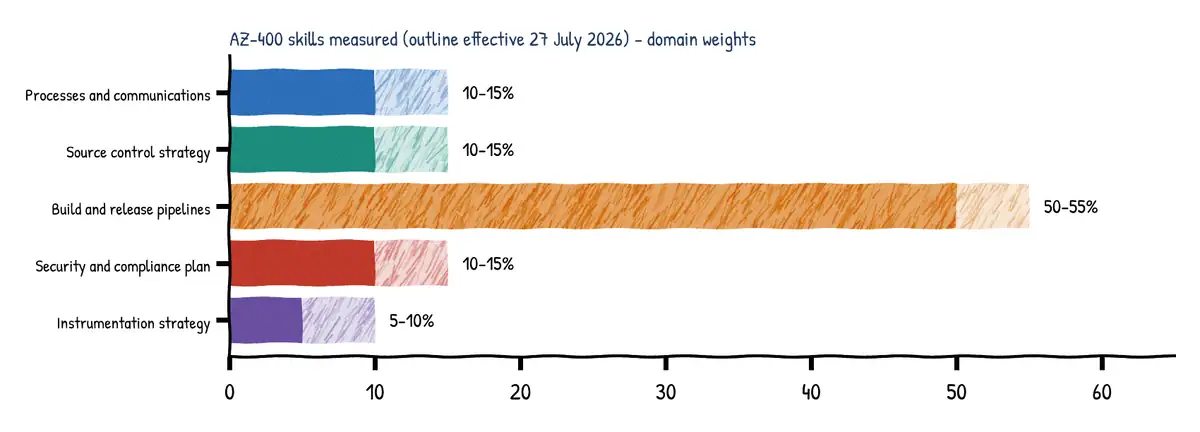
Build and release pipelines is worth half the exam. Package management, testing, YAML pipelines, deployment strategies, infrastructure as code and pipeline maintenance together make up 50-55% of the score. Chapters 4 to 9 cover them, and roughly half the practice questions in this guide are in that domain.
Question formats you will meet
Microsoft role-based exams use a standard set of item formats. Every practice question in this guide is original and uses these formats so you get used to them:
| Format | What it looks like | How this guide practises it |
|---|---|---|
| Multiple choice | One correct answer out of 4 | type: single |
| Multiple response | 'Select TWO/THREE' - all parts must be right | type: multi |
| Solution series (Yes/No) | Same scenario, a different proposed solution each time | type: yesno, in series of 2-3 |
| Build list / drag and drop | Put actions in the right sequence | type: order |
| Hot area / matching | Match items to settings, or pick values in YAML | type: match |
| Case study | Long company scenario followed by several questions | type: case |
| Labs (sometimes) | Perform tasks in a live portal | the 30 hands-on labs in Part III |
How this guide is organized
- Part I - Concepts (Chapters 1-12). Each chapter starts with the skills-outline bullets it covers. Then come explanations, diagrams, comparison tables, YAML/CLI/Bicep/KQL examples, Exam tip boxes and Watch out boxes for common traps.
- Part II - Practice questions. Over 580 original questions, grouped by chapter. The answers and explanations follow each set. Every explanation also says why the wrong options are wrong.
- Part III - Hands-on labs. 30 labs with goals, prerequisites, steps, solution code, verification checks and stretch goals.
- Part IV - Mock exam. 60 questions weighted like the real exam, with an answer key.
- Appendix - Quick reference. YAML, Git, Azure CLI and KQL snippets for the last week before the exam.
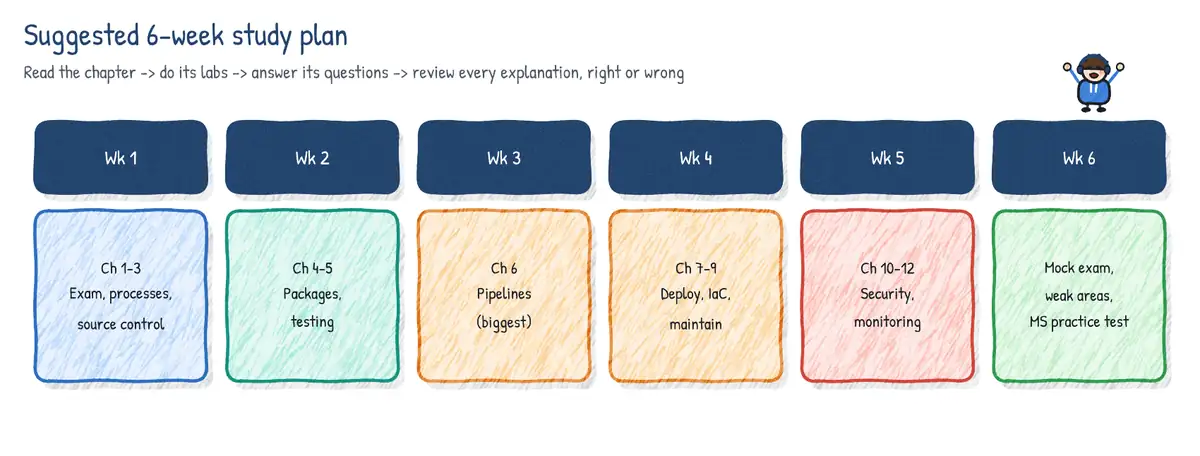
About the screenshots
Images labelled Illustrative mockup are re-drawn recreations of Azure DevOps screens, such as branch policies, a pipeline run and an environment approval. They show where settings live and what they are called. They are not exact copies of the product UI, which changes often. When you do the labs, compare them with your own portal.
A DevOps mindset in one page
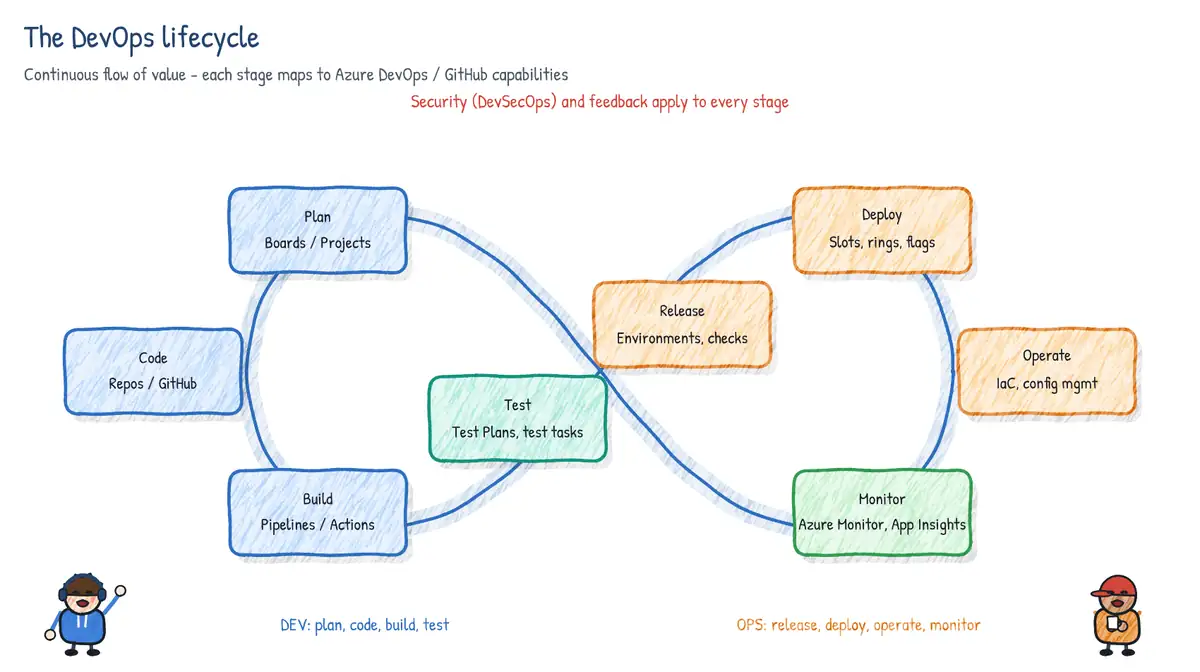
Microsoft defines DevOps as the union of people, process and products to enable the continuous delivery of value to end users. The exam tests whether you can choose the practice or service that shortens feedback loops without losing quality or security. Most scenario questions come down to one of these principles:
- Automate everything repeatable: build, test, infrastructure, deployment, security scans.
- Small batches, fast feedback: short-lived branches, PR validation, frequent deployment.
- Least privilege and no long-lived secrets: managed identities, workload identity federation, Key Vault.
- Progressive exposure and fast recovery: rings, canaries, feature flags, slot swaps, rollback.
- Measure and learn: DORA metrics, telemetry, dashboards, alerts wired back to work items.
- Choose the simplest native option that meets the requirement. Exam answers usually prefer built-in Azure DevOps or GitHub features over custom scripts.
Exam-day technique
- Read the last sentence first: it tells you what is being asked (minimize cost? administrative effort? downtime?).
- Underline the constraints: 'without storing secrets', 'least privilege', 'minimize administrative effort', 'must support on-premises'.
- Eliminate options that break a constraint, then pick the most native or managed one.
- Use the open-book documentation only for quick fact checks (a task name, a YAML keyword). Browsing costs time.
- Case studies can come before or after the main section. Budget about 20-25 minutes for them.
- Mark uncertain items for review, but always answer them. There is no penalty for guessing.